Something new from DigiCom: Checkout Required. After managing $200M+ in ad spend for DTC brands, we've learned the best answers rarely come from a playbook. They come from operators comparing notes on what's working right now. So we built Checkout Required, a community for DTC and Shopify founders, operators and marketers to swap real numbers, ask questions and learn from each other. It's also the new home for our podcast, webinars and operator dinners.
This issue is a preview of what you'll find inside, straight from our latest podcast episode.
Black Friday is November 27. That gives you about six weeks, and most brands win or lose BFCM in October, not on the day. If you've got one ad in one ad set spending $2,000 a day and going nowhere, our media buying team says it's probably not the ad. It's the offer, the landing page or the account structure, and all three need to be settled before the peak. In our latest episode of Performance Anxiety, John, Danielle, Hemant and Mike walk through what they test first and the rules they use to tell the difference.
The episode
It's Always the Offer: What Our Media Buyers Are Changing on Meta Before BFCM
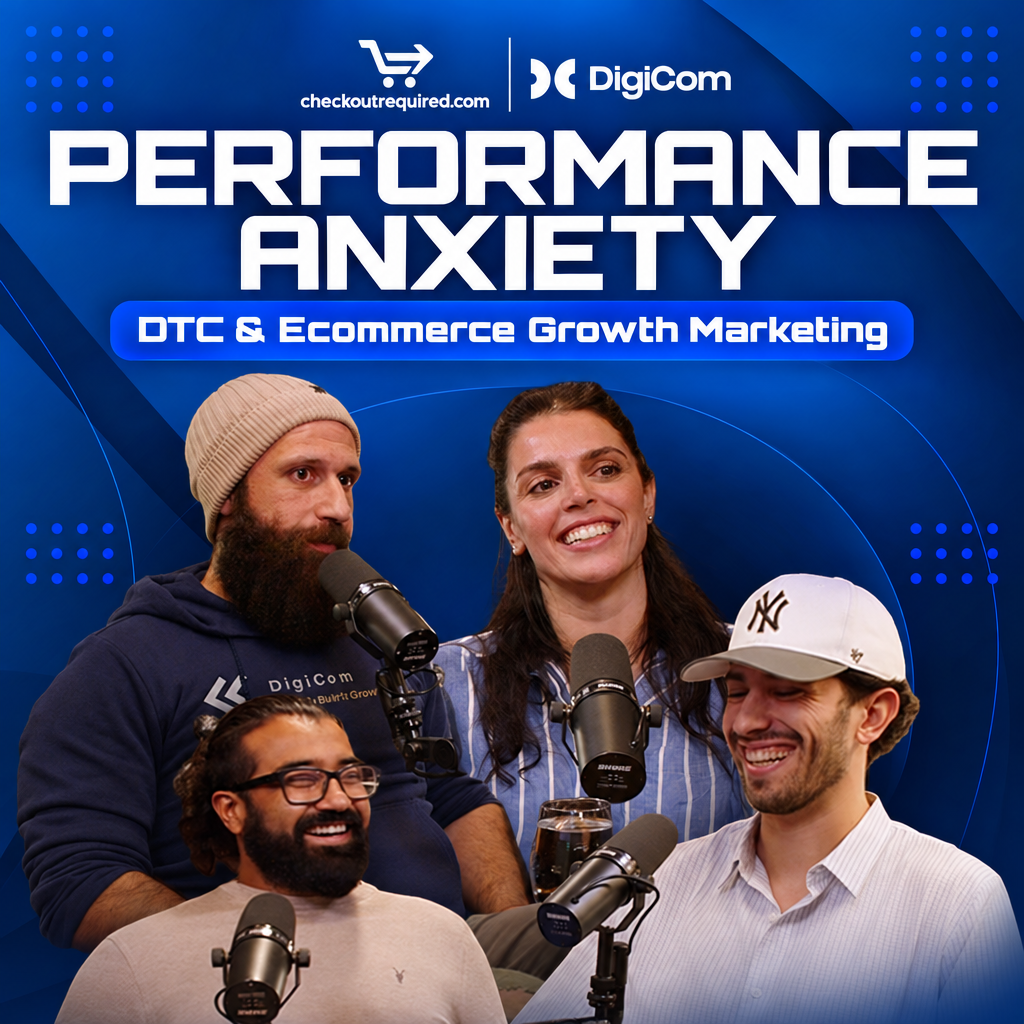
John, Danielle, Hemant and Mike from the DigiCom media buying team | Watch on YouTube / Listen to the podcast
Your BFCM countdown
- Now to October 31: test offers and prices while results are still clean and you have room to learn.
- November 1 to 20: launch your BFCM creative and landing pages, and build your retargeting audiences.
- November 21 to December 1: run what you proved. Pause on rules, not panic.
What we covered
1. Lock your BFCM offer before you touch the ad
Every brand runs a discount in November. The offer is the one lever you can't fix mid-weekend, so it's the first thing to test now. The team's diagnosis loop runs structure, creative, copy, landing page, offer. When an account stalls, they change a non-creative variable first. If performance moves, it was never a creative problem.
Offers move the most. For one client they tested 25% off against a buy-more/get-one offer, and the bundle roughly doubled revenue. Price counts too: a $200 to $180 drop worked for another client, and small moves like $55 to $49 get you under a round number without giving up much margin, primarily because CVR improvements offset the drop in AOV.
Messaging is part of the offer. The same product priced at "$6 a day" beat "$5 dollars a day" by a wide margin. Run that same framing check on your BFCM headline before it goes live.
"It's not always the ad. If we're going to get into it, the offer plays a big part." (the DigiCom team)
Try this: Before October ends, put your two strongest BFCM offers head to head (for example a bundle against a percent off) on a separate landing page that only gets Meta traffic. Take the winner into Black Friday.
2. Build your BFCM landing page now, and match it to the ad
A supplement brand had ads that wouldn't spend. The team kept the same landing page and put the influencer (a doctor) at the top of it. Those ads went to 5 to 6x scale week-over-week in an account that spends $20,000+ a day.
Conversion rate didn't beat the PDP. CPMs and CPCs got much cheaper because the ad-to-page match reached a different pocket of the audience. That matters more in November, when everyone is bidding for the same shoppers and cheaper reach is worth real money.
"It was the same landing page. They put the influencer at the top, and all of a sudden it scaled 5-6X. The CPMs and CPCs were so much more efficient because it was reaching a different audience pocket." (the DigiCom team)
Try this: Build your BFCM landing page this month with the creator or expert from your best ad above the fold. Run it against your PDP now and judge it on CPM and CPC first, not just conversion rate.
3. Brief BFCM creative for variety, not versions
Under Andromeda, similar creatives get the same entity ID. Same creator, same setting, same text overlay style, and Meta treats them as one ad. Ten versions of the same "Black Friday sale" graphic can end up competing as a single ad while the rest spend pennies.
The fix is a matrix of personas by awareness stage (unaware, problem aware, solution aware) with a concept in each cell. Then launch a mixed set: 2 videos, 3 carousels, 1 GIF, 3 statics, 8 to 10 ads that cover the funnel and every format.
Small details matter too. Identical creative on a broad audience got a 30% hook rate from the influencer's handle and 13% from the brand handle. If you have creator partners, line up partnership ads for BFCM now.
"If it's the same creator, the same setting, the same style of text overlay, Meta is going to see those as one ad and assign the same entity ID." (the DigiCom team)
Try this: Map your BFCM creative by persona and awareness stage, then brief concepts for the empty cells. Aim to have the mixed set live in early November so you go into the peak with proven ads.
4. Write your BFCM pause rules before the weekend
On Black Friday there's no time to debate an ad, so set the numbers now. Day-over-day reads don't work anymore. Judge on 2 to 3 day windows, pause and restart often, and leave an ad on once you see a pattern (two or three conversions after a restart).
Pause earlier than your target suggests. If target CPA is $40 and the ad converts once at $41 CPA, pause it around $80, not $70, to allow it to hit your target. Fatigue shows up as frequency up, CPM up, CTR down. Check Shopify before you trust a lucky conversion.
Don't pause the anchors. One top-of-funnel ad ran at $0.25 to $0.30 CPC against a $1.60 account average, with a high new-visitor share and frequency under 2 over a month. It stayed on at double the CPA because the rest of the account converted off its traffic.
"This has got $0.20, $0.30 CPCs, the rest of my account is at $1.60. I'm not pausing that. It's feeding the entire engine." (the DigiCom team)
Try this: Write a one-page rule sheet for each account before November 21: target CPA, pause threshold, restart rule, and which anchor ads stay on no matter what.
5. Spend budget to learning
Every account should put 10 to 20% of monthly budget into testing, because a strong creative carries performance for 2 to 3 weeks and then it's done. The team's own example: lo-fi ads came in around $70 against a $40 target while in-car videos hit $30, so they moved budget to the videos and shelved lo-fi through the end of Q4.
Structure is a test too. Try ABO at 10% of budget, then 15% if it beats your CBO setup. It only works if you can feed it.
Retargeting has gone manual. The Advantage+ audience settings over-served existing customers in consolidated structures and pushed frequency up, so the team turned it off and built dedicated campaigns around engaged and existing customers.
Try this: Put 10 to 20% of October spend into tests, and launch one manual retargeting campaign before November.
Your next steps this week
- Pick your two strongest BFCM offers and start a head-to-head test on a landing page fed only by Meta traffic.
- Build a BFCM landing page with the creator or expert from your best ad above the fold, and test it against your PDP.
- Map your creative by persona and awareness stage, then brief BFCM concepts for the empty cells.
- Write your pause, restart and anchor-ad rules for the November 21 to December 1 window.
- Set aside 10 to 20% of this month's budget for tests and set up one manual retargeting campaign.
Watch the full episode on YouTube
Join the conversation
Six weeks out, the most useful thing you can do is compare notes with operators running the same tests. Bring your offer results, questions and BFCM plans to the community.
The Checkout Required team